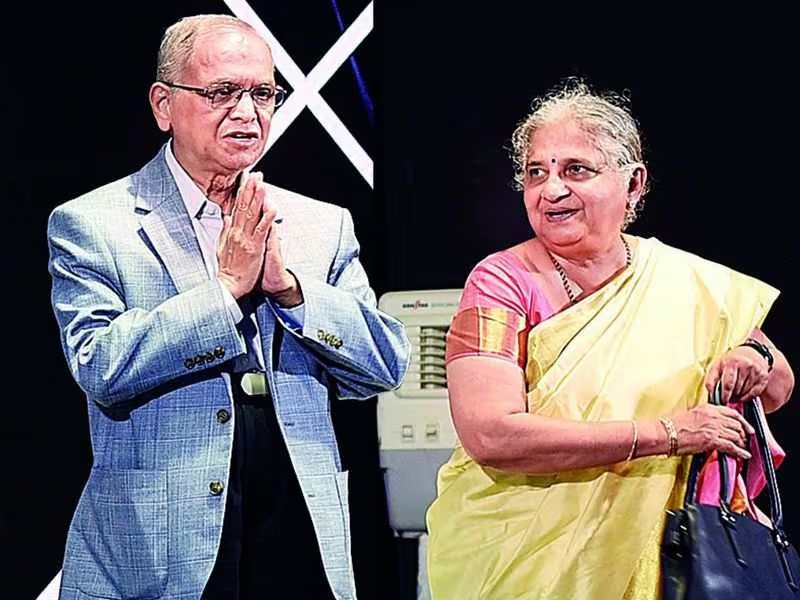
Infosys founders Narayana Murthy and Sudha Murty have declined to participate in Karnataka’s ongoing caste-based Social and Educational Survey. Citing that they do not belong to any backward community, the couple opted out of the enumeration process, sparking public discussion on voluntary participation and social identity.
Couple opts out of caste enumeration
Infosys founder Narayana Murthy and his wife, author and philanthropist Sudha Murty, have chosen not to participate in the Karnataka government’s Social and Educational Survey, commonly referred to as the caste survey. When survey enumerators visited their residence, the couple reportedly stated, “We don’t want the survey conducted at our home.”
Sudha Murty also submitted a signed self-declaration form to the Karnataka State Backward Classes Commission, affirming that they do not belong to any backward community and therefore declined to provide caste-related information.
Context of the survey
The Karnataka government launched the caste-based survey to gather data on the social and educational status of various communities across the state. The initiative aims to inform policy decisions and welfare schemes by understanding the demographic composition of the population.
While participation is not legally mandatory, the survey has seen mixed responses from citizens, with some expressing concerns over privacy and classification.
Key highlights of the development
- Narayana Murthy and Sudha Murty declined to participate in Karnataka’s caste survey
- The couple stated they do not belong to any backward community
- A self-declaration form was submitted by Sudha Murty to the commission
- The survey is being conducted by the Karnataka State Backward Classes Commission
- Participation in the survey is voluntary, not compulsory
- The incident has sparked broader conversations on caste identity and data collection
Public response and broader implications
The Murthys’ decision has drawn attention to the voluntary nature of the survey and the broader debate around caste-based enumeration. While some have praised their transparency, others argue that participation from influential figures could help normalize the process and encourage wider engagement.
The Karnataka government has reiterated that the survey’s purpose is to ensure equitable development and that all data collected will be kept confidential.
Sources: The Hindu, The Daily Jagran, Telegraph India